PixVerse R2: Scaling Real-Time Omni World Models
PixVerse R1 introduced and shipped the first real-time video world model, turning video generation from a one-shot delivery of a fixed clip into a continuously running world. The model can keep receiving user input, update world state in real time, and stream synchronized audio and video that stay consistent with the interaction. R1 showed that this technical paradigm can work.
PixVerse R2 answers the next question: how a real-time video world model keeps scaling. R2 focuses on two goals. First, it builds a dynamic world that can hold a unified state over long horizons, converting full spatiotemporal priors into world evolution that only moves forward in time. Second, it continuously internalizes physical causality and interaction signals from text, reference, audio, and action into a single model, so the world can generate, receive control, and update state at the same time while streaming synchronized audio and video.
Around those goals, R2 turns growth in the model, data, tasks, control signals, and time scale into gains in generation quality, long-range consistency, and multimodal control.
Overall Framework
R2 collapses the system into two core layers: Omni Causal AR and Real-Time Acceleration. Omni Causal AR keeps expanding high-quality, multimodal, long-horizon world generation. Real-Time Acceleration inherits those capabilities as losslessly as possible under a strict interaction-latency budget. The path is clear: raise the world model’s capability ceiling, then accelerate that capability into a real-time, interactive operating range.
Older long-video and real-time pipelines usually chained many training stages: convert a bidirectional model into an AR model, build a distillation teacher from a task-specific bidirectional model, run DMD distillation, then add self-rollout DMD to close the train-inference gap. Each stage had to remigrate capability, realign objectives, and re-fit the data distribution. Picture quality, motion, condition following, and long-horizon stability could erode during those transfers. As model, data, and task scale grew, the multi-stage pipeline split the optimization target and raised both training cost and system complexity.
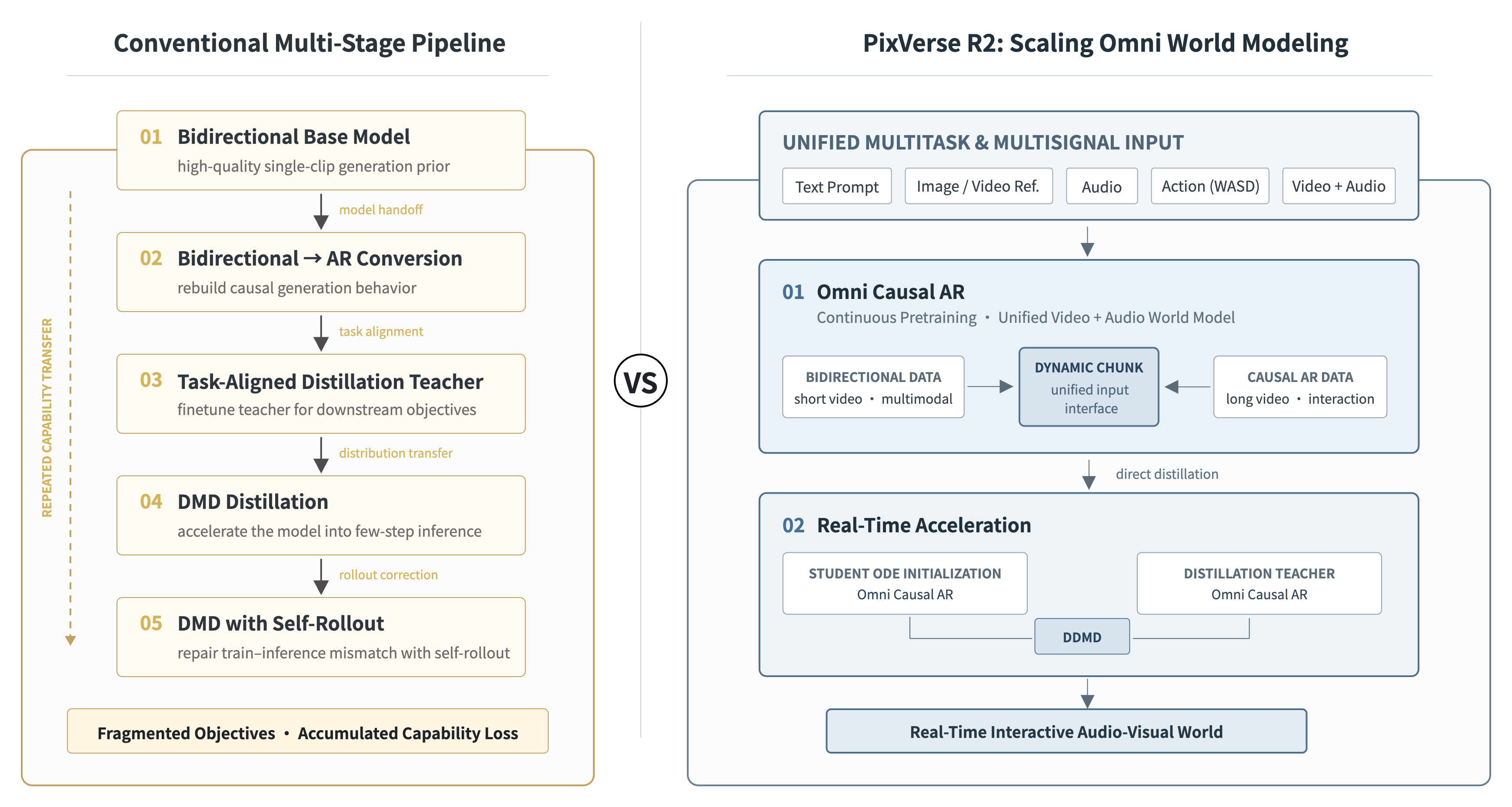
Figure 1. Legacy multi-stage pipeline versus PixVerse R2 scaling world modeling. R2 converges capability expansion and real-time distillation into Omni Causal AR and a real-time acceleration layer, unifying multi-task, multi-signal, and long-video modeling in one framework.
PixVerse R2 proposes a unified training paradigm for real-time world models. Instead of repeatedly migrating capability across many models and task stages, it reduces the complex pipeline to two processes that can keep scaling: continually pretrain an Omni Causal AR that holds a unified world state, then distill it directly into an accelerated model that can generate in real time while inheriting spatial consistency and long-horizon modeling.
Fewer stage boundaries reduce the capability loss that comes from independent teachers, task alignment, and repeated model transfers. New data, tasks, control signals, and model scale can convert more directly into real-time world-modeling ability.
Stage 1: continual pretraining of Omni Causal AR. R2 no longer treats bidirectional generation priors and long-video AR as two disconnected stages. It continually trains a unified Omni Causal AR on top of bidirectional-model capability. Dynamic chunks give different data forms a shared temporal representation: the model can absorb high-quality short video and multimodal data from bidirectional pretraining, and it can expand into continuous long video and multi-turn interaction trajectories. Picture quality, audiovisual expression, long-horizon generation, and multi-signal control can scale inside one model instead of being remigrated through repeated conversions.
Stage 2: distill a real-time acceleration layer from the scaled Omni Causal AR. Continual pretraining gives Omni Causal AR high-quality generation, stable long-horizon state transfer, and real causal rollout at the same time. R2 then uses the same Omni Causal AR for both student ODE initialization and the distillation teacher, so teacher, student, and real AR inference share a consistent causal modeling base. Real-time distillation becomes “few-step acceleration of an existing world model,” not “relearning a long-horizon world.”
Omni Causal AR
R2 continues the multimodal input, autoregressive generation, and real-time interaction path that R1 already validated, then concentrates those capabilities into a unified Omni Causal AR training route. Omni Causal AR converts full spatiotemporal generation priors into world-state transfer that only moves forward in time. Through causalization and continual pretraining, the model keeps picture, motion, audio, and multimodal semantic ability while learning to predict the next synchronized audiovisual chunk from history alone.
As training objects expand from independent short videos to continuous long videos and multi-turn interaction trajectories, the model gradually builds long-term causality among historical world state, current interaction input, and future world evolution.
The model jointly receives a text prompt, multimodal references, action signals (for example WASD or continuous control), and audio, and it outputs synchronized video and audio. Different control signals can keep entering the model during a run and change later world state. R2 is not only responding to a one-shot condition; it can generate, receive control, and update the world at the same time.
To keep causal generation inside the same world over a long run, R2 addresses four problems: train-inference distribution gap, robustness to noisy history, coordination of long-term and recent memory, and correction of error states. Hybrid Teacher / Diffusion Forcing lets the model adapt to both clean and noisy history. Multi-Timescale Memory jointly stores world anchors, recent dynamics, and object state. An Error Bank brings failed states back into training. Together they form a training loop for long-term world state and reduce drift in picture, character, motion, audio-visual relationship, and control response over time.
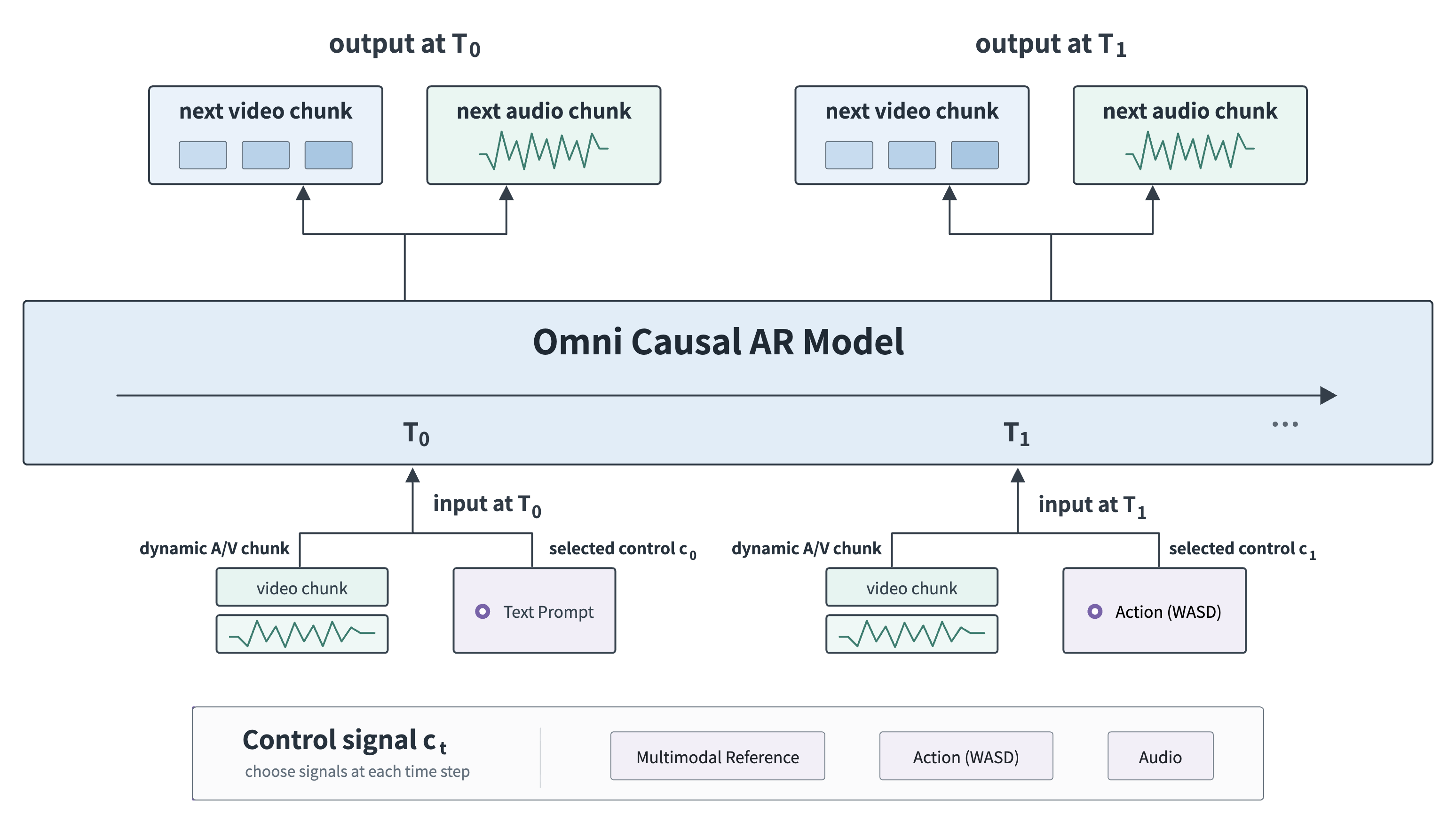
Figure 2. PixVerse R2 Omni Causal AR. The model can keep receiving different control signals during a run. At each interaction moment, the active signal aligns with a dynamic audiovisual chunk at the matching granularity and drives the next video and audio segment.
Dynamic chunk generation
Different control signals live on different timescales. Prompts and references usually describe full semantics or longer events. Action (WASD) needs fine-grained, immediate state feedback. Audio carries semantics, rhythm, and temporal sync at once. If every input is forced into a fixed-length time unit, the model often has to trade response speed against completeness of expression.
Dynamic Chunk is how R2 unifies those interaction timescales. R2 adaptively splits audiovisual sequences by the semantic boundary and duration of the current control signal, with a maximum chunk size that constrains compute and training stability. Short chunks improve response precision for action and local instructions. Long chunks keep the full structure of events, motion, and audiovisual semantics. Different tasks and control signals can share one causal generation interface without switching model structure.
Hybrid Teacher Forcing / Diffusion Forcing
The core tension in long-horizon AR is that training history is usually cleaner, while real runtime history contains the model’s own noise and local errors. Training only on clean history can raise the single-step quality ceiling but make the model too sensitive to small deviations. Training only on perturbed history can hurt picture quality, motion, and control response.
R2 mixes clean history and noisy history in one training process. Clean history stabilizes the quality ceiling of world evolution. Noisy history lets the model adapt in advance to imperfect states it will see in deployment. The complementary training shrinks the train-inference gap, so the model can generate a high-quality next world segment and keep rolling forward when history already contains a small error.
Causal Attention Mask and Relative Temporal RoPE jointly constrain which history the current state can read and where that history sits in the current window. Attention Mask enforces strict causal visibility. Temporal RoPE does not grow without bound with a global block ID; it is re-indexed by relative slot inside the current attention window. When the rolling window moves forward, real time keeps advancing, but sink memory, recent history, and the current chunk stay mapped to a stable, bounded relative position range.
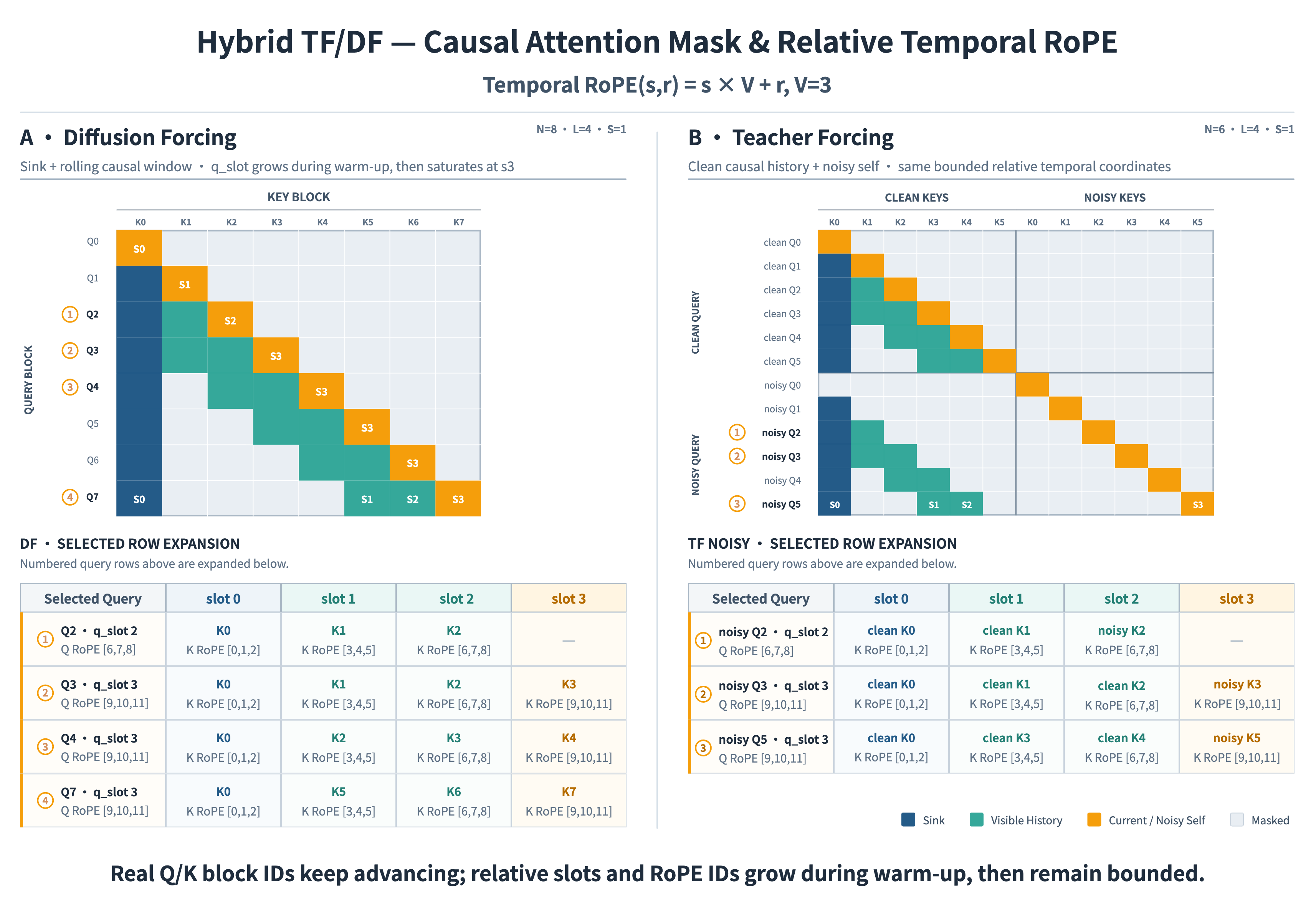
Figure 3. Unified causal attention mask and relative temporal RoPE for Hybrid Teacher / Diffusion Forcing. The top shows causal visibility for the two history constructions. The bottom maps representative queries to Q/K blocks, relative slots, and RoPE IDs, showing that real block IDs keep advancing while in-window time coordinates stay bounded.
Multi-timescale memory
Long-term world modeling cannot simply remember all history. Unbounded history raises compute and memory cost quickly; over-cropping drops character identity, scene setup, and key events. R2 builds a multi-scale memory system from Sink Memory, Rolling History, and an Object KV Cache.
- Sink Memory stores long-term anchors such as character, scene, style, and world rules.
- Rolling History focuses on recent action, pose, camera, and environment change so local state can connect naturally.
- Object KV Cache reuses and compresses already-computed object-level history representations, keeping the states that actually affect later evolution inside a limited budget.
The three together give long-term identity stability, short-range motion continuity, and controllable runtime cost, and they reduce character drift, scene jumps, cross-chunk flicker, and broken action.
Error Bank
Serious drift in an AR world model often starts from a small early error written into history and then inherited. R2 builds an Error Bank that stores representative error histories as reusable samples and replays them into normal history at a set rate during training. The model no longer only learns how to continue from an ideal state; it also learns how to recognize, absorb, and repair history that has already drifted.
In staged evaluation, the long-term brightness-drift metric fell from 0.201 to 0.129, about a 35.8% drop. Of 29 long-sequence samples, 20 improved, and all 5 samples that were explicitly supposed to stay still reduced erroneous motion.
Real-Time Acceleration
R2’s real-time acceleration does not relearn a long-horizon world inside a few-step model. It accelerates a world model that can already run stably for a long time. The acceleration layer starts from the continually pretrained Omni Causal AR and uses it for both student ODE initialization and the distillation teacher, so teacher, student, and real AR inference share a consistent causal trajectory distribution.
That unified causal starting point reduces dependence on Self-Forcing and Rolling Forcing style tuning. Real-time acceleration can focus on the problems few-step speed actually introduces: DDMD with adversarial regularization handles condition alignment, generation distribution, and realism during distillation; block-sparse attention compresses long-context compute; and a pyramid path lowers the cost of high-resolution generation.
DDMD with adversarial regularization
In ultra-few-step generation, condition alignment, distribution matching, and realism are not the same optimization problem. R2 is based on DDMD and further introduces adversarial regularization from DMD2. Three training signals meet in one student: condition alignment strengthens control, distribution matching keeps the teacher distribution, and adversarial regularization anchors real data, so few sampling steps can keep both accurate interaction response and a believable world.
Block-sparse attention
R2 uses block-sparse attention on spatiotemporal token sequences. The model splits Q, K, and V into compute blocks, quickly estimates which key/value blocks each query block most needs, keeps only the highest-scoring connections, and runs exact softmax attention on those selected blocks. Block-level routing is not random pruning; it concentrates compute on the strong dependencies among current multimodal control, recent motion, and key world state.
By adapting the model to the sparse connection structure during training, R2 raises attention sparsity above 90% while keeping picture quality, action continuity, condition following, and long-horizon stability without a clear drop in current evaluation.
Pyramid ultra-few-step distillation
Doing all world modeling from scratch in high-resolution space wastes compute on global structure that a lower resolution can already determine. R2 organizes generation as one or two low-resolution stages plus a high-resolution stage. The low-resolution stages set scene layout, subject motion, and camera structure. The high-resolution stage restores texture, edges, and local detail. The coarse-to-fine path cuts repeated high-resolution compute while keeping stronger structural stability and detail.
Conclusion and Limits
PixVerse R1 proposed and shipped the first real-time video world model, showing that video can move from offline fixed content to a dynamic world that can interact in real time and keep running. PixVerse R2 then solves how that paradigm keeps scaling: a unified Omni Causal AR carries growing data, tasks, modalities, and timescales, and Real-Time Acceleration brings full world-modeling capability into real-time few-step inference.
R2 is not a single-point capability upgrade. It is a unified training path for the next generation of real-time world models. R1 made real-time video world models real. R2 puts them into a unified, scalable, continually improving stage.
Under a strict real-time compute and interaction-latency budget, current single-generation quality still has room to improve versus leading offline video models, especially in complex scene detail, motion naturalness, physical consistency, and stability over long runs. Those gaps more often reflect R2’s current scaling stage than a ceiling of the framework itself.
Early Access
As of August 23, 2026, this report described PixVerse R2 as closed testing. On September 22, 2026, PixVerse announced that a collection of these worlds is open to explore at world.pixverse.video. See the R2 launch announcement.
That announcement does not open unrestricted API access. The PixVerse world model R2 experience form remains the request route for early experience and API access.
Related Resources
- PixVerse R1 Explained: Real-Time AI Video World Model
- PixVerse Game Engine Deep Dive
- PixVerse Updates R1 with Shared Worlds
- Real-Time AI Video Generation Guide
- PixVerse Closes Series C Extension
Worlds from the September 22, 2026 announcement are open to explore at world.pixverse.video. API access is still requested through the form above. You can also create with PixVerse V6 and R1 today.