Open-Source Image Models for Commercial Use: License Guide
Source-based overview; facts checked Oct 19, 2026. Speed, quality and benchmark claims are vendor-reported unless stated otherwise. Prices and early-access terms change; check provider pages before budgeting.
Last updated: Oct 19, 2026
Choosing open-source image models for commercial use starts with permission: can you deliver client images, operate a paid feature, or train a model for your product? Downloadable weights do not answer those questions.
As of Oct 19, 2026, BFL’s Klein license offers a conditional commercial-output exception; Qwen’s Turbo license requires separate commercial permission; Iris-3B uses Apache 2.0. FLUX Kommunity and Qwen Research are source-available, open-weights licenses rather than OSI open source; Apache 2.0 is an OSI license. For freelancers, agencies and indie SaaS builders, the useful distinction is between image delivery, model operation and training. This is a plain-language summary, not legal advice; read the license text before commercial use.
Commercial Use at a Glance
These are license permissions, not quality scores. BFL’s FLUX Kommunity terms, Qwen’s Research Agreement and the Iris repository establish the distinctions below. Read each row with its conditions.
| Model | License | Commercial use of images | Run in production | Fine-tune for commercial use | Redistribution | Key conditions |
|---|---|---|---|---|---|---|
| FLUX 3 Image Klein | FLUX Kommunity v1.0 | Yes, if Qualifying User: combined gross annualized revenue < US$5M | Qualifying Users only, solely to generate permitted outputs | No blanket grant; commercial training needs scope review and BFL permission where outside the grant | License + BFL Attribution Notice; mark modifications; subject to permitted purposes | Include affiliates; filtering or output review; legally required AI disclosure; prohibited uses apply |
| Qwen-Image-2.1-Turbo | Qwen Research | Separate commercial license required | Commercial production requires separate license | Separate commercial license required | Agreement + Notice; mark changed files; research/evaluation scope | Research or evaluation only; distributed-model attribution where applicable |
| Iris-3B | Apache 2.0 | Yes, under permissive model terms | Yes, subject to license conditions | Yes, subject to license conditions | License + relevant notices; state changes | Retain NOTICE and applicable third-party notices; review component licenses |
The US$5M figure is BFL’s revenue eligibility threshold, not an image quota or project budget. “Yes” describes the model license; it does not clear rights in a particular picture.
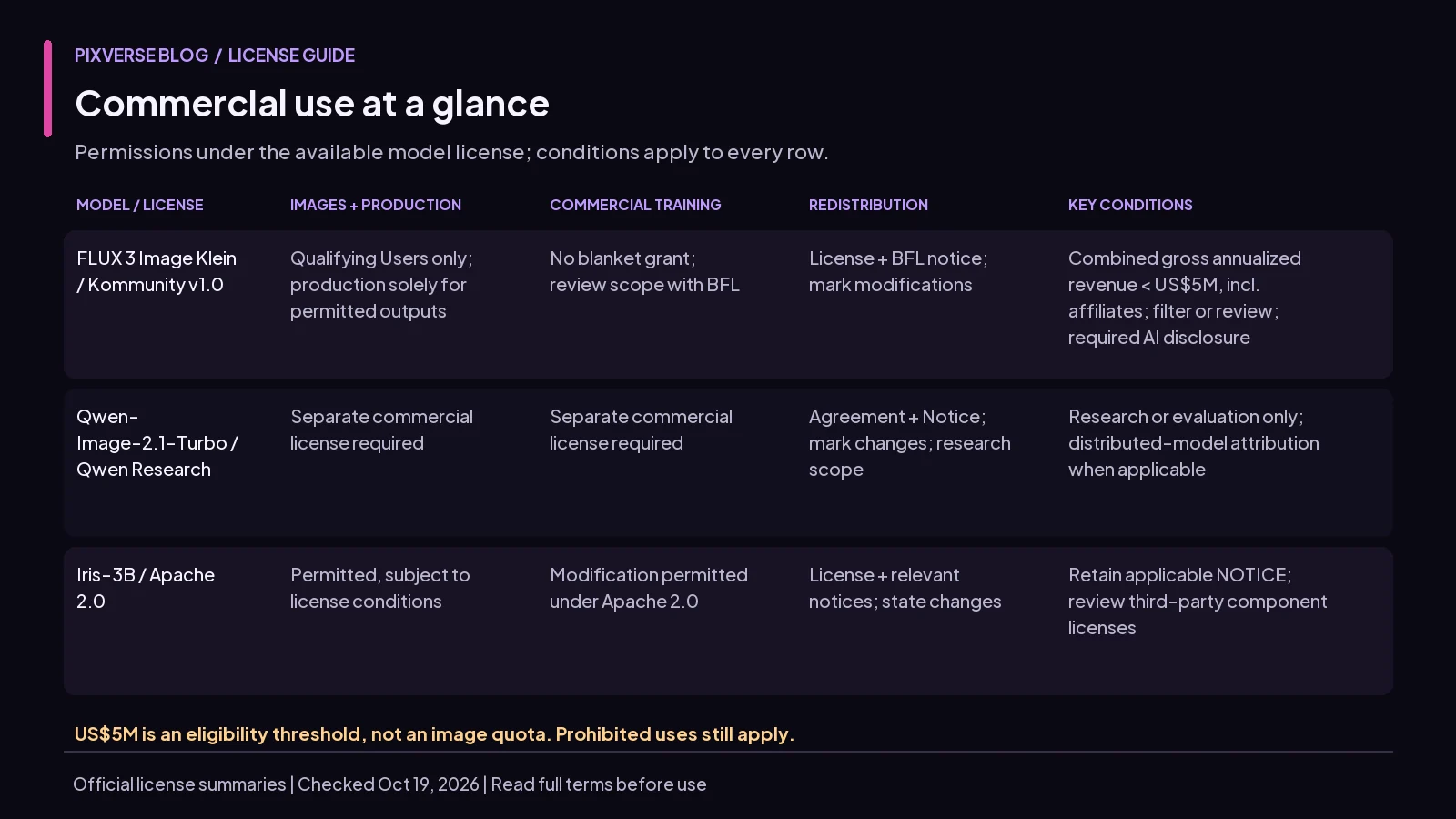 Self-made summary of the official license texts checked Oct 19, 2026; conditions remain part of every permission.
FLUX 3 Image Klein: the US$5M Qualifying-User Rule
BFL’s model card identifies FLUX Kommunity licensing. Its license, sections 1(e) and 2(a), defines eligibility using your gross annualized revenue together with affiliates: it must be less than US$5,000,000. Exactly US$5M does not satisfy that wording. Assess the contracting user and affiliates, rather than revenue from one commission.
For a Qualifying User, BFL permits commercial use of outputs, including outputs from derivatives, and production operation solely to generate those outputs. This is a limited exception. Revenue-generating use, end-user interactions or impacts, and training, fine-tuning or distilling other models commercially are excluded from its definition of non-commercial purposes.
BFL’s section 2(e) requires content filtering or review before distributing outputs, plus AI disclosure to the extent legally required. Its redistribution provisions require the license, BFL Attribution Notice and modification statements. Section 4 prohibits uses including military activity, surveillance, biometric processing and unlawful or infringing content. These obligations are not removed by revenue eligibility.
The definition of derivatives includes fine-tunes and certain models trained using synthetic outputs or distillation; images themselves are not derivatives. Crucially, section 4(b) also prohibits improving another AI model with a similar function using the model, derivatives or outputs. Selling a picture and training another generator therefore require different checks. Obtain BFL permission for commercial activity outside the express grant.
As of Oct 19, 2026, BFL describes paid licensing tiers: Builder has 10K images/month and one domain for internal operations and marketing, excluding client use; Platform has 100K/month for SaaS end-user features; Professional covers agency work with the first three clients included; Enterprise offers custom terms. These are BFL-reported plan allowances, separate from the revenue threshold. The page lists no prices; confirm scope directly before choosing.
Qwen-Image-2.1-Turbo: Research Only Unless Licensed
Qwen’s Turbo model card identifies the Qwen Research License Agreement, consistent with the official project repository. The LICENSE file, bearing a September 20, 2026 agreement release date, defines non-commercial use as “research or evaluation purposes only.” It requires a separate license for commercial use and directs requests to [email protected].
Do not treat a locally generated image for a paid campaign as research merely because nobody buys the checkpoint. For this release, downloading and experimenting do not supply commercial permission. Keep a commercial deployment out of the release plan until its separate agreement covers the intended activity.
Qwen also requires recipients to receive the agreement, changed files to carry modification notices and distributed materials to retain its Notice. If materials or outputs train or improve an AI model that is distributed or made available, related product documentation must prominently display “Built with Qwen” or “Improved using Qwen.” Attribution does not replace commercial authorization.
Apply this finding specifically to Qwen-Image-2.1-Turbo. Do not transfer a license assumption from a differently named Qwen release or a roundup’s “commercial-friendly” label.
Iris-3B: Apache 2.0 With Notices
Sperid Labs describes Iris-3B as a three-billion-parameter pixel-space model producing roughly one-megapixel images, with a four-step distilled Turbo variant (vendor-reported). Its paper is arXiv:2610.09450. Those specifications identify the model; they do not establish quality or licensing superiority.
The official repository’s LICENSE and NOTICE identify Apache 2.0. Under the Apache text, commercial operation, modification and distribution are permitted with conditions. Redistributors must provide the license, retain relevant notices, identify changed files and carry applicable NOTICE attribution. The license also contains patent provisions and does not grant general trademark permission.
Sperid’s repository NOTICE lists separately downloaded dependencies, including the Qwen3-VL-4B-Instruct text encoder under Apache 2.0 and Dion under MIT. Preserve the notices relevant to what you ship and inspect component terms. A permissive top-level license is a reason to maintain a clear dependency record, not to discard it.
Which License Fits Your Use?
Use the BFL, Qwen and Apache terms to classify the activity before committing to infrastructure:
- Freelancer below US$5M: Klein’s commercial-output exception may fit if combined affiliate revenue qualifies and all conditions are met. Iris offers permissive model terms. Qwen Turbo still requires separate commercial permission.
- Agency above US$5M: Klein’s free exception does not apply. Discuss client coverage with BFL; its Builder tier expressly excludes client use. A small campaign budget does not change organizational revenue eligibility.
- SaaS image feature: For Klein, review the narrow output-generation grant and eligibility together. End-user interaction is not non-commercial testing. For Qwen Turbo, obtain commercial terms; for Iris, retain applicable license and component obligations.
- Training on generated outputs: Do not carry image-delivery permissions into training. Klein’s derivative definition and similar-model prohibition matter; Qwen’s commercial restriction and distributed-model attribution matter. Review the full training pipeline and data rights separately.
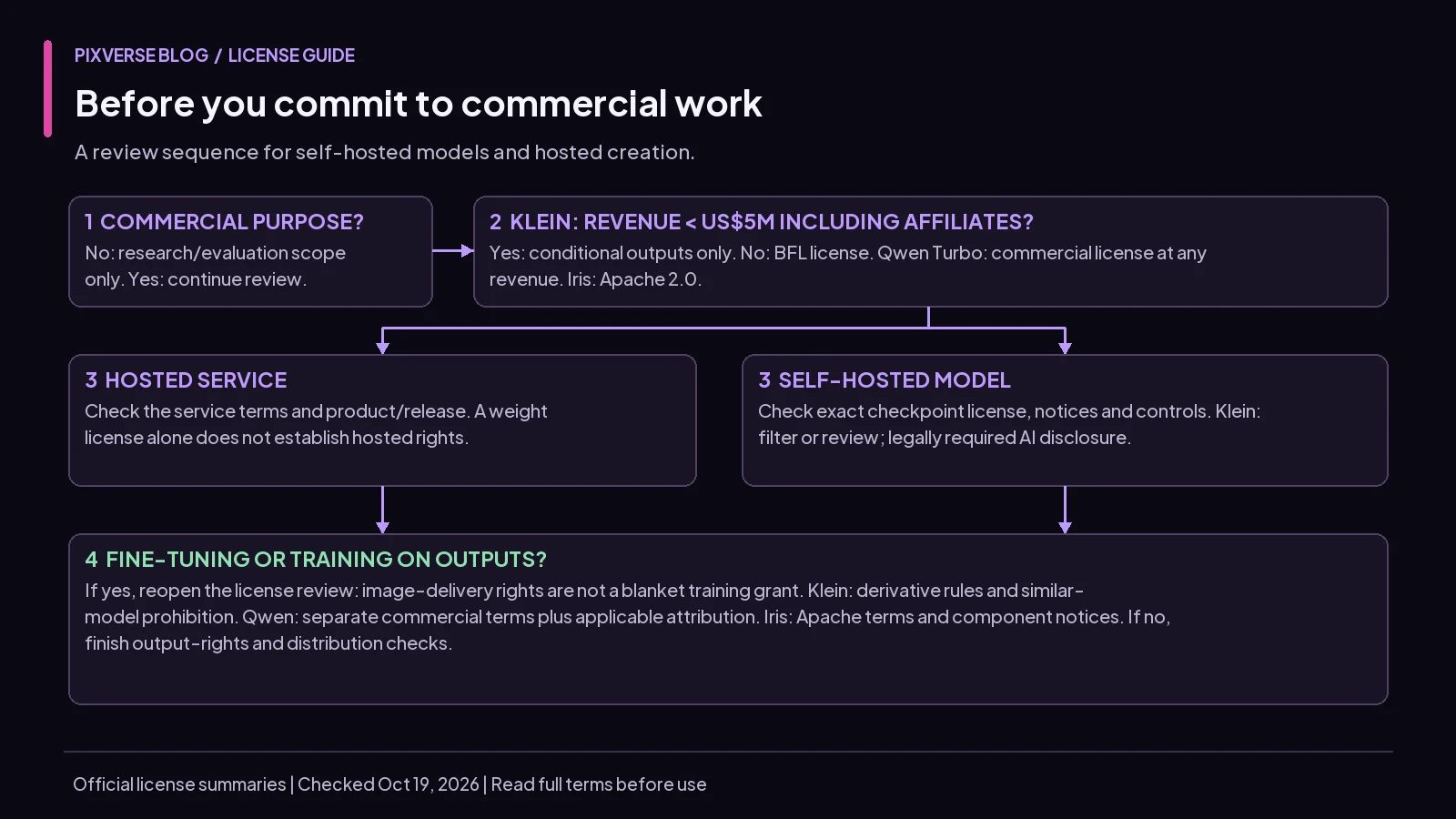 Self-made review flow; follow the model-specific conditions instead of treating a revenue check as universal permission.
Checklist Before You Ship Commercial Work
Keep a short licensing record alongside each project:
- Save the exact license: record checkpoint, revision, retrieval date and any separate commercial agreement.
- Package notices: retain required license and attribution files, identify modifications and inventory downloaded dependencies.
- Document output controls: for Klein’s exception, record filtering or review before distribution.
- Check AI disclosure: establish how required disclosure reaches the delivered asset or product.
- Recheck revenue: for Klein, assess combined gross annualized revenue including affiliates before relying on eligibility.
- Review hosted-service terms: a hosted workflow is governed by that service’s terms as well as relevant model arrangements. Consult our commercial-use FAQ below; do not infer service permissions from a weight license.
Assign an owner to these checks before handoff. If the workflow changes from delivering images to distributing weights or training a product model, reopen the review.
FAQ
Can I use FLUX 3 Image Klein images commercially?
Under BFL’s license, yes for Qualifying Users below US$5M in combined gross annualized revenue, including affiliates, with filtering or review, required disclosure and other conditions. Outside the grant, request a BFL license.
Is Qwen-Image-2.1-Turbo free for commercial use?
No. Qwen’s LICENSE limits the available grant to research or evaluation. Commercial use requires a separate agreement; giving attribution alone is insufficient.
Which open image model has the most permissive license?
Of these three, Iris-3B has the most permissive commercial licensing framework: Apache 2.0. Preserve required notices and check components and intended content before delivery.
Can I fine-tune these models for a commercial product?
Iris permits modification under Apache 2.0. Qwen Turbo requires separate commercial terms. For Klein, the output exception is not blanket commercial-training permission; check derivative rules and prohibited uses with BFL.
When your workflow moves from stills to video, create with PixVerse and review the commercial-use FAQ below for that service’s terms.
Related Resources
- FLUX 3 Image Klein local setup and deployment guide
- PixVerse commercial-use policy FAQ for hosted creation
- Hosted Qwen Image 2.0 on PixVerse — a different release from Qwen-Image-2.1-Turbo; this is not a claim that PixVerse hosts Turbo, Klein or Iris.