Odyssey-3 vs PixVerse R2: Real-Time World Models Compared
Source-based overview; facts checked Oct 19, 2026. Speed, quality and benchmark claims are vendor-reported unless stated otherwise. Prices and early-access terms change; check provider pages before budgeting.
Last updated: Oct 19, 2026
Odyssey-3 vs PixVerse R2 is a choice about what you want to do inside a generated world. PixVerse announced R2 on September 22, 2026; Odyssey launched its research preview on October 8, 2026, a little over two weeks later. A real-time world model generates a continuing environment that responds to inputs while the experience runs.
For creators, the useful distinction is between exploring a prompted scene and designing an interaction whose consequences should persist. Both companies describe interactive systems, so those interests overlap. This article compares their stated design and access routes, then explains how to read the benchmark evidence. It offers no head-to-head quality ranking: the reviewed Physics-IQ Verified leaderboard has no PixVerse R2 entry as of October 19, 2026.
Odyssey-3 vs PixVerse R2 at a Glance
Product capabilities below are vendor-reported. Dates and access descriptions refer to the linked announcements, rechecked October 19, 2026; missing information means the reviewed sources do not establish it.
| Comparison | Odyssey-3 | PixVerse R2 |
|---|---|---|
| Launch announcement | October 8, 2026; research preview | September 22, 2026; follows R1, introduced January 2026 |
| Access as of October 19, 2026 | Public Flash research preview, linked by the launch page | Collection of worlds at world.pixverse.video, per the launch announcement; confirm authoring access separately |
| Inputs | Environment prompts, actions and events | Text, reference images, audio and actions |
| Control | First-person, third-person and independent camera | WASD character movement; arrow-key camera control |
| Memory emphasis | Previous observations condition subsequent predictions | Running world state carries earlier inputs through a session |
| Reported resolution | Base: 832×480; Pro: 1280×720 | No directly comparable output resolution stated in the reviewed launch announcement |
| Published Physics-IQ Verified results; protocols differ | Pro V2V: 66.1 best-of-8; 63.37 four-run average (±0.63), vendor-reported | None published in the reviewed leaderboard as of October 19, 2026 |
Sources for the capability and resolution rows: Odyssey’s launch page, PixVerse’s R2 announcement and Odyssey’s benchmark submission. The table does not equate different benchmark protocols or infer a score for R2.
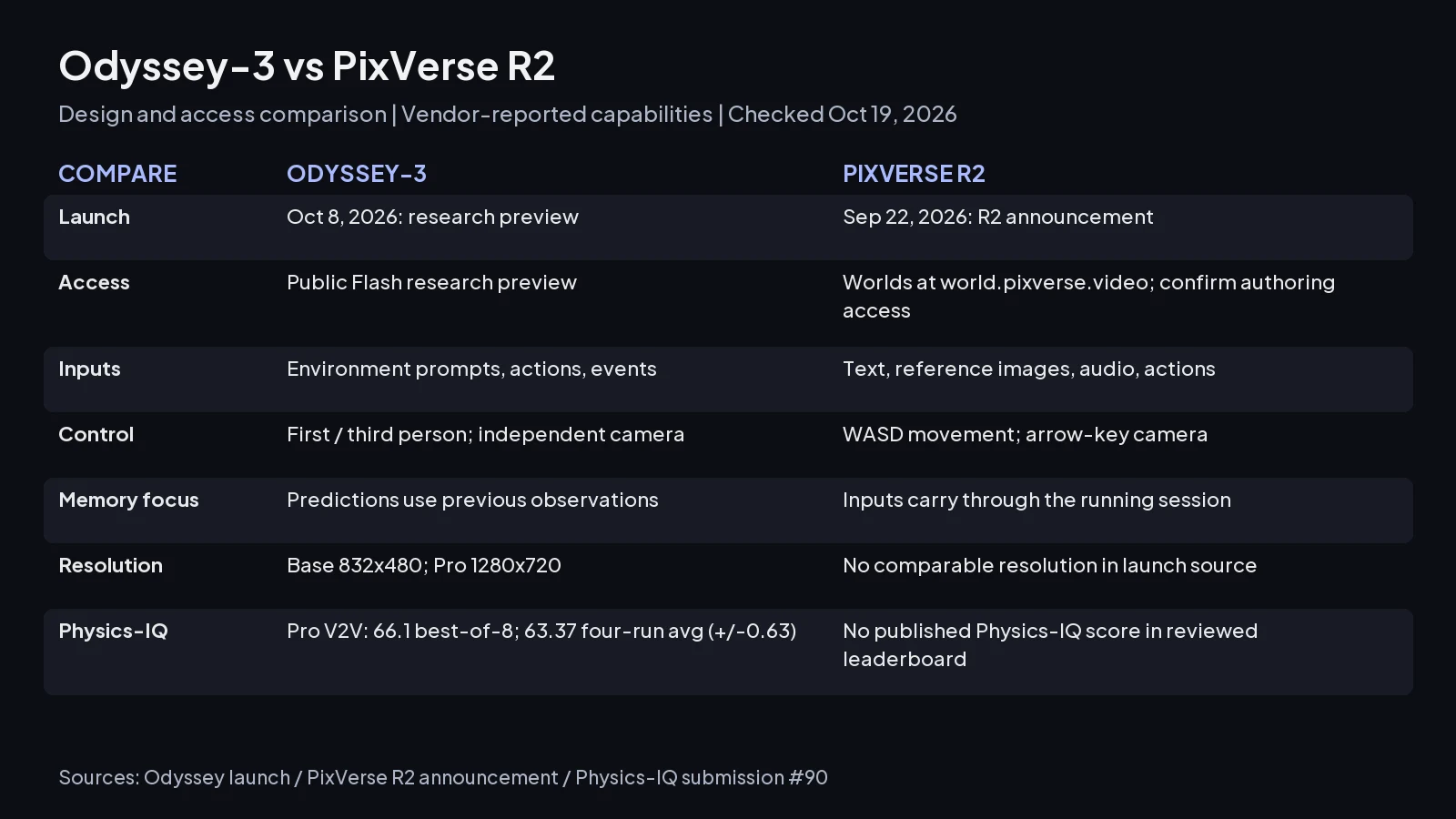 Self-made comparison of vendor descriptions, checked October 19, 2026. Benchmark measurements and access routes are labeled separately.
What Odyssey-3 Does
Odyssey says its October 8, 2026 preview lets you prompt an environment, navigate in first or third person, move the camera independently and introduce events. The launch button identifies the public experience as Flash. Treat that as the model you can inspect through the preview, rather than assuming a Pro benchmark describes your session.
The company’s earlier September 15, 2026 technical introduction describes an autoregressive diffusion transformer: it predicts subsequent observations using learned world knowledge. This helps explain the appeal for visual exploration. You can think of a scene as something to enter, inspect and disturb, rather than deciding its entire sequence before generating it.
Odyssey also reports first place in three of four WorldMark categories in its own October 8, 2026 evaluation. That is a vendor-run result about generated worlds, separate from the Physics-IQ physical-prediction task.
For a first experiment, write a setting with recognizable landmarks, take a short route, turn the camera and inspect the scene again. Record what remains recognizable and what changes unexpectedly. This is an evaluation exercise, not a tested prompt or a promise of geometric consistency.
Odyssey also reports adapting the foundation to robots and other systems through learned action decoders in its technical introduction. Those demonstrations do not establish robot-control access in the public exploration preview. Likewise, a Pro result should remain attached to Pro rather than becoming a claim about every Odyssey-3 variant.
What PixVerse R2 Does
PixVerse’s September 22, 2026 announcement describes session memory, multimodal inputs and live character control; it says the PixVerse Game Engine runs on R2 and offers worlds to explore at world.pixverse.video. These are vendor descriptions of the system and its examples, not independent measurements of unlimited persistence.
PixVerse describes its architecture as Omni Causal AR plus a real-time acceleration layer in that announcement. For implementation context, read the R2 technical report; the practical question here is whether an earlier choice still matters later in an interaction.
Suppose you are sketching a mystery: the participant finds a key, speaks to a character and returns to a locked door. Your design needs the key’s role to remain meaningful throughout. Use that proposed sequence as a review checklist wherever an experience supports it. Session continuity does not by itself establish saved progress between separate visits, and an exploration destination does not establish unrestricted access to a game-authoring workflow.
Reading the 66.1 Physics-IQ Score: Best-of-8 vs 63.37 Four-Run Average
66.1 is a best-of-8 result (vendor-reported); the four-run average is 63.37. Odyssey reports these Pro V2V results in its leaderboard submission, with ±0.63 sample standard deviation for the average. Its launch page’s footnote distinguishes four-run averages from a single best-of-8 run. These figures answer different questions about a generation procedure. The leaderboard also labels this result as “custom prompts”.
The Physics-IQ repository evaluates physical understanding using videos of real experiments. Generated continuations are compared with observed outcomes across physical phenomena. It is useful evidence about those tasks, but it is not a direct test of whether a participant enjoys a story, understands its controls or can reliably finish a game.
V2V and I2V also provide different starting information. In Odyssey’s submission, V2V conditions on a video segment, while I2V starts from a single frame. The Pro I2V headline rounds to 54.7, but the precise submitted 54.69 is also a single best-of-8 result, rather than a four-run mean (vendor-reported). Keep that protocol attached to the number.
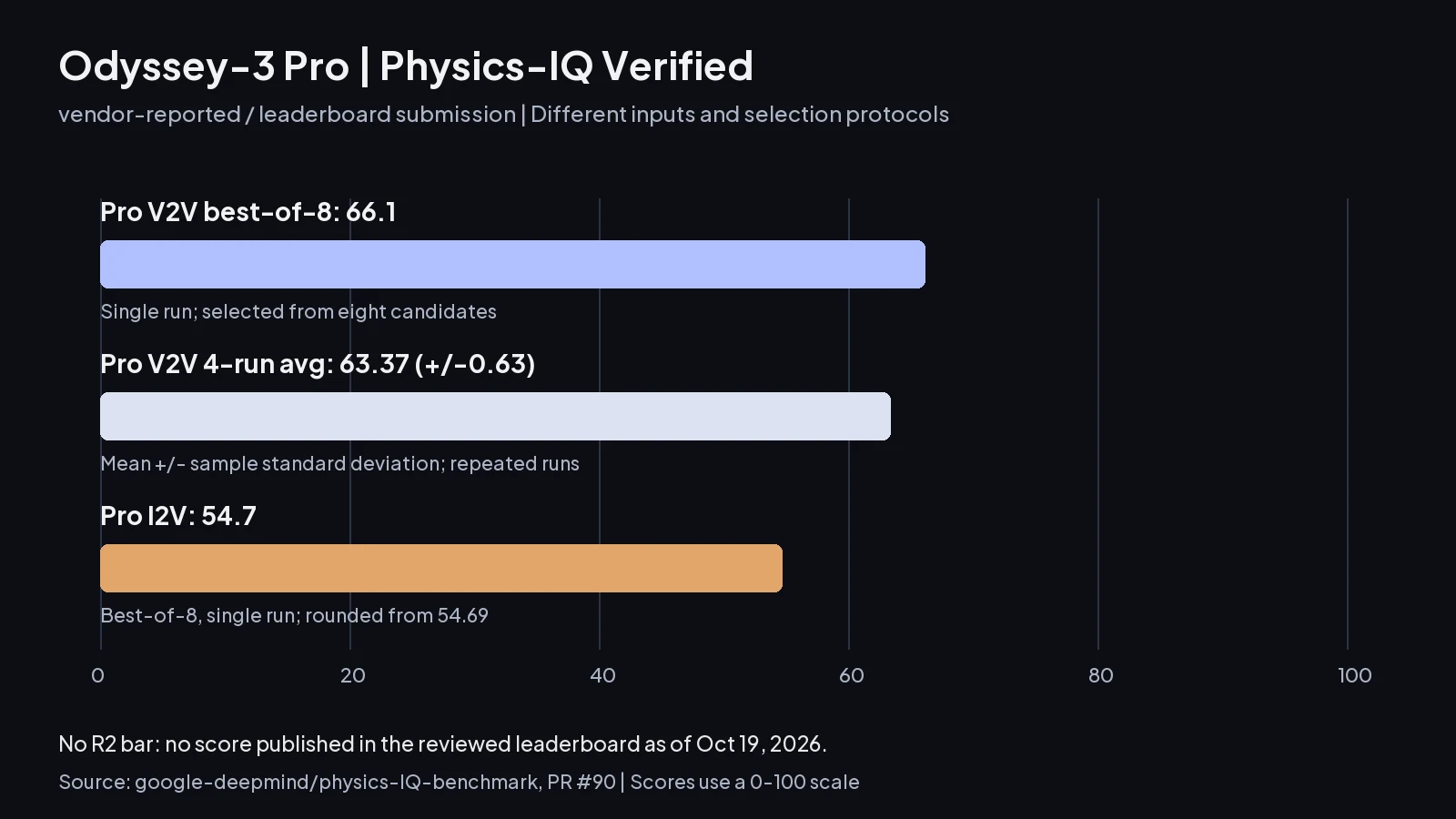 Vendor-reported / leaderboard submission: Pro V2V 66.1 best-of-8 and 63.37 four-run average (±0.63); Pro I2V 54.7 is best-of-8, rounded from 54.69. R2 has no bar because no score is published in the reviewed leaderboard.
Best-of-8 selects among candidate generations; the four-run mean summarizes repeated runs under the submitted protocol. The leaderboard rules permit single-run inclusion but require four runs with standard deviation for a state-of-the-art claim. A listed result therefore needs methodological context before it becomes a record headline.
For research, read the selection procedure and prompt settings alongside the score. For creative work, keep a separate notebook of navigation, continuity and recovery observations. Neither the benchmark nor a compelling demo supplies all the evidence needed for a production decision.
Which One Should You Try?
Choose a small task before choosing a model. The following are suggested evaluation scenarios, not results from our own hands-on comparison:
- Explore a scene from a prompt: Start with Odyssey’s Flash research preview, linked in its October 8, 2026 announcement. Inspect a landmark from different viewpoints and note where your sense of place holds up. Keep conclusions specific to the preview variant and the session you observed.
- Plan a persistent game world: Start with the R2 design described in PixVerse’s September 22, 2026 announcement. Explore an available world, then write down which action should affect a later event. Confirm the authoring route before committing a project schedule; the announcement identifies the Game Engine connection without establishing universal builder access.
- Investigate physical prediction: Start with the Physics-IQ methodology and the Odyssey submission. Keep model variant, input mode, prompts, selection method and repeated-run statistics together. R2’s absence supplies no evidence that it performs better or worse.
Both are early options for this decision. Keep the initial exercise short enough to repeat, and define success in advance: recognizable landmarks, an understandable response or a remembered consequence. Save examples of failures as well as successes. That gives a collaborator something concrete to assess when deciding whether a larger prototype is justified.
FAQ
Is Odyssey-3 free to use?
As of October 19, 2026, Odyssey offers a public research preview. It is widely reported as free to try; The Decoder reports this in its October 11, 2026 article. Check the preview site for current terms. Odyssey’s launch page does not itself publish a free-price promise.
What does Odyssey-3’s 66.1 best-of-8 score mean beside its 63.37 four-run average?
66.1 is a best-of-8 result (vendor-reported); the four-run average is 63.37, with ±0.63 standard deviation, for Pro V2V in Odyssey’s submission. The first uses candidate selection in a single run; the second summarizes repeated runs. Neither should be substituted for the other.
Does PixVerse R2 have a Physics-IQ score?
None is published in the reviewed Physics-IQ Verified leaderboard as of October 19, 2026. That leaves no shared benchmark basis for ranking R2 against Odyssey-3. Compare the documented controls and access routes, then evaluate your intended interaction directly.
Can I build a game with either model?
PixVerse says its Game Engine runs on R2 in the September 22, 2026 announcement; confirm access for your intended project. Odyssey’s October 8, 2026 public preview centers on environment exploration. The reviewed material does not establish an equivalent publicly accessible game-authoring workflow there.
To continue your creative work, open PixVerse.