4K AI Video Cost: Native FLUX 3 vs 1080p + Upscale
Source-based overview; facts checked Oct 16, 2026. Speed, quality and benchmark claims are vendor-reported unless stated otherwise. Prices and early-access terms change; check provider pages before budgeting.
Last updated: Oct 16, 2026
Should you generate a new shot at 4K, or generate 1080p and upscale it? On OpenRouter’s FLUX 3 Video listing, the provider-reported 4K generation rate is $0.41 per second as of Oct 16, 2026. Our calculation from list prices puts a ten-second shot at $4.10, versus approximately $5.67 for 1080p generation followed by Precise upscaling to 3840 × 2160.
That makes the single-request 4K option the cheaper starting point for a new shot on these listings. Existing footage changes the decision: its generation cost is already spent. For per-second rates across ad models, see our AI ad video cost comparison. Here, we focus on the resolution bill.
Original title card by PixVerse Blog: two routes to a 4K deliverable.
What Changed: FLUX 3 Video Now Renders 2K and 4K
In its September 10 release notes, BFL says FLUX 3 Video added qhd and uhd beyond the previous FHD ceiling. BFL reports 2560 × 1440 for qhd and 3840 × 2176 for uhd at its 16:9 setting.
“Native 4K” here means selecting 4K in the generation request. BFL says every class above hd uses the same generation, with its internal video upsampler rendering a different canvas. This is a workflow distinction; it does not establish that either route looks better.
For delivery, distinguish BFL’s 2176-pixel canvas height from conventional 3840 × 2160 UHD. Confirm whether your pipeline crops or resizes it. The separate-upscale estimates below use a specified 2160-pixel output height, so their megapixel charges are reproducible.
4K AI Video Cost per Second by Provider
These are USD provider list prices checked Oct 16, 2026, rather than measured production costs. OpenRouter lists the following generation tiers; BFL reports its direct 2K/4K rates; fal lists its own text-to-video prices.
| Provider and operation | 720p | 1080p | 2K | 4K |
|---|---|---|---|---|
| OpenRouter generation | $0.17/s | $0.29/s | $0.28/s | $0.41/s |
| BFL direct text/image-to-video | — | — | $0.40/s | $0.80/s |
| fal text-to-video | $0.17/s | $0.29/s | $0.32/s | $0.47/s |
The dashes mean the direct pricing page did not render those figures during our check. They do not mean the tiers are unavailable. OpenRouter’s 2K listing is below its 1080p listing; use the published values rather than assuming resolution determines price monotonically.
BFL’s direct 4K rate is roughly double OpenRouter’s: our calculation from list prices, $0.80 ÷ $0.41 ≈ 1.95. Provider differences may reflect launch pricing, but these pages do not establish an expiry date.
For continuation, OpenRouter lists $0.41/$0.53/$0.31/$0.45 per second at 720p/1080p/2K/4K respectively. BFL reports $0.65/$0.95 for direct 2K/4K continuation. Do not use the cheaper new-shot rate to budget an extension.
How FLUX Video Upscale Is Priced
OpenRouter describes FLUX Video Upscale as a separate model with 1.5×–3× enlargement, unchanged duration, an optional prompt, and Precise or Creative modes. It lists a release date of August 19, 2026.
As of Oct 16, 2026, OpenRouter lists $0.035 per output megapixel-second for Precise and $0.05 for Creative. BFL’s release notes report direct rates of $0.07/$0.10 respectively. In its official X post on Oct 15, 2026 (UTC), OpenRouter announced one week of early access for the upgraded FLUX Video Upscale. These OpenRouter prices may change around Oct 22, 2026; that date is our estimate from the announced week, not a guaranteed expiry or long-term rate.
BFL defines one megapixel as 1,048,576 pixels, with output area multiplied by duration. Its listed basis is 24 fps; supported higher frame rates scale charges proportionally. Use delivered dimensions, rather than the source file’s resolution, for the upscale bill.
For 3840 × 2160 output, our calculation from list prices is:
- 3840 × 2160 = 8,294,400 pixels; divide by 1,048,576 to get 7.91015625 MP.
- OpenRouter Precise: 7.91015625 × $0.035 ≈ $0.277 per output second.
- BFL direct Precise: 7.91015625 × $0.07 ≈ $0.554 per output second.
Thus, “about $0.28/s” describes one output configuration. It is not a flat upscale rate. A different canvas or frame rate changes the equivalent price.
Native 4K vs 1080p + Upscale: 10-Second Worked Example
All totals below are our calculation from list prices, Oct 16, 2026, for ten seconds at 24 fps. Generation uses OpenRouter’s rates except BFL’s direct 4K rate in E. Upscale rates come from OpenRouter and BFL’s release notes. Separate upscaling targets 3840 × 2160; round only the final total.
| Route | Generation | Separate upscale | Total |
|---|---|---|---|
| A. OpenRouter single-request 4K | 10 × $0.41 = $4.10 | None | $4.10 |
| B. OpenRouter 1080p + Precise | 10 × $0.29 = $2.90 | 10 × 7.91015625 × $0.035 ≈ $2.77 | ≈ $5.67 |
| C. OpenRouter 1080p + Creative | $2.90 | 10 × 7.91015625 × $0.05 ≈ $3.96 | ≈ $6.86 |
| D. OpenRouter 2K + 1.5× Precise | 10 × $0.28 = $2.80 | ≈ $2.77 | ≈ $5.57 |
| E. BFL direct 4K versus mixed-provider route | Direct: 10 × $0.80 = $8.00; alternative: OpenRouter 1080p $2.90 | Alternative: BFL Precise ≈ $5.54 | $8.00 versus ≈ $8.44 |
E deliberately combines OpenRouter generation with BFL direct upscaling. It is not a verified all-BFL 1080p quote. For D, 2560 × 1440 enlarged 1.5× produces the target canvas.
For B/C/E, prepare a 1920 × 1080 source before 2× enlargement. BFL reports a 1920 × 1088 FHD canvas; doubling that uncropped frame gives 3840 × 2176. Our calculation from list prices then puts B at approximately $5.69 instead. Include any crop or resize work in your production budget.
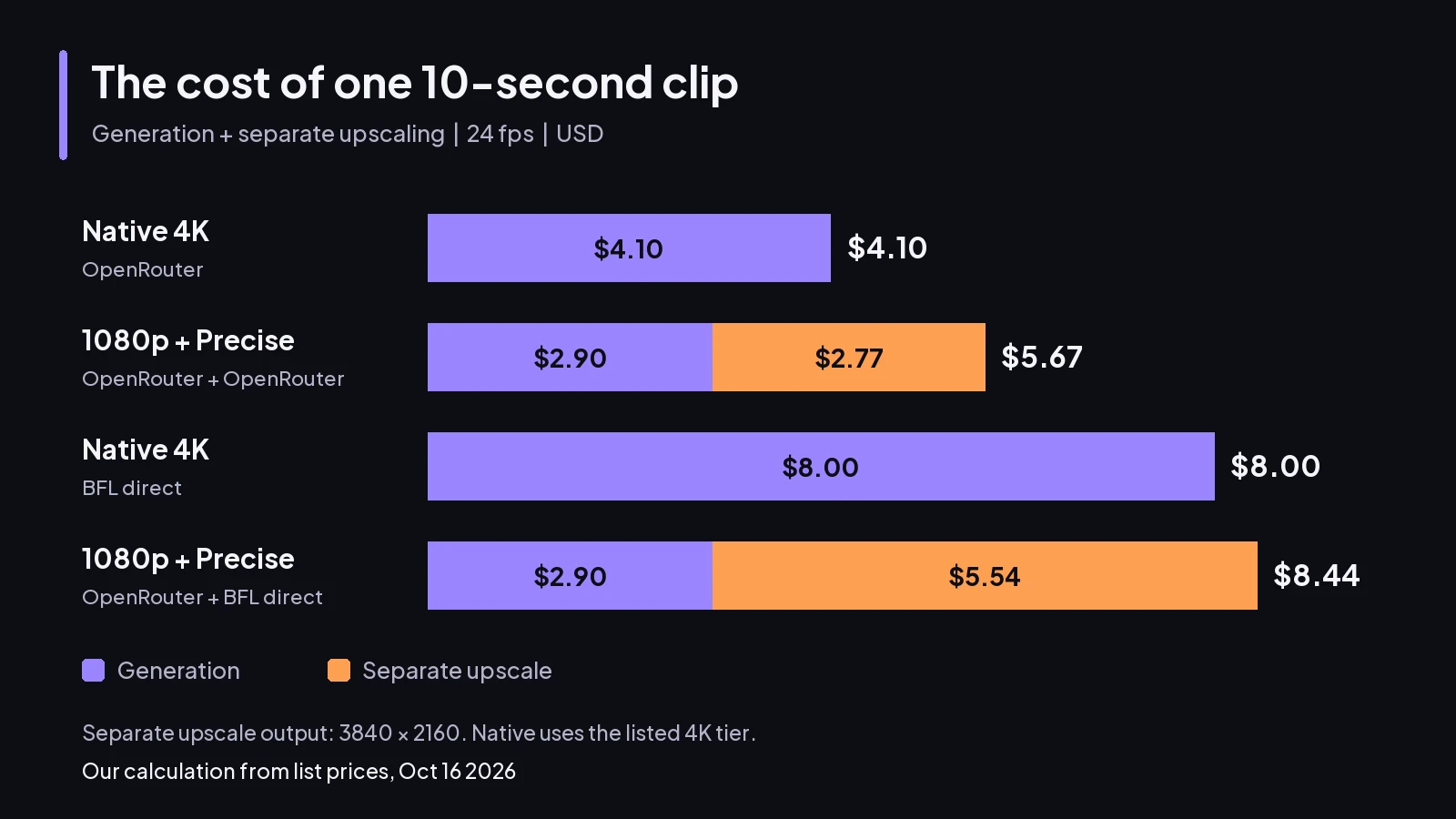
Our calculation from list prices, Oct 16, 2026. Third bar: BFL direct native 4K, $8.00. Fourth: OpenRouter generation plus BFL direct Precise; separate upscale output is 3840 × 2160 at 24 fps.
Use this formula with your chosen providers:
cost = seconds × generation_rate
     + seconds × (output_width × output_height / 1,048,576)
       × upscale_rate_per_MP_second × (fps / 24)
For existing footage, set the new generation term to zero. For single-request 4K, omit the separate upscale term. These estimates cover generation and upscaling; add your editing and review costs separately.
When Upscaling Is the Right Call
An approved 1080p take, an older clip, or footage from another model makes upscaling worth evaluating. You are buying a larger deliverable while keeping the chosen source. On OpenRouter’s Oct 16 listing, Precise costs $0.035/MP-second; our calculation from list prices gives approximately $2.77 for ten existing seconds at the specified UHD output.
For a new shot, A avoids a separate finishing job and its waiting time. We observed OpenRouter’s reported 644 seconds P50 end-to-end latency for the upscaler on Oct 16, 2026. This was OpenRouter’s measured telemetry at that date, not our timing test or a promised turnaround.
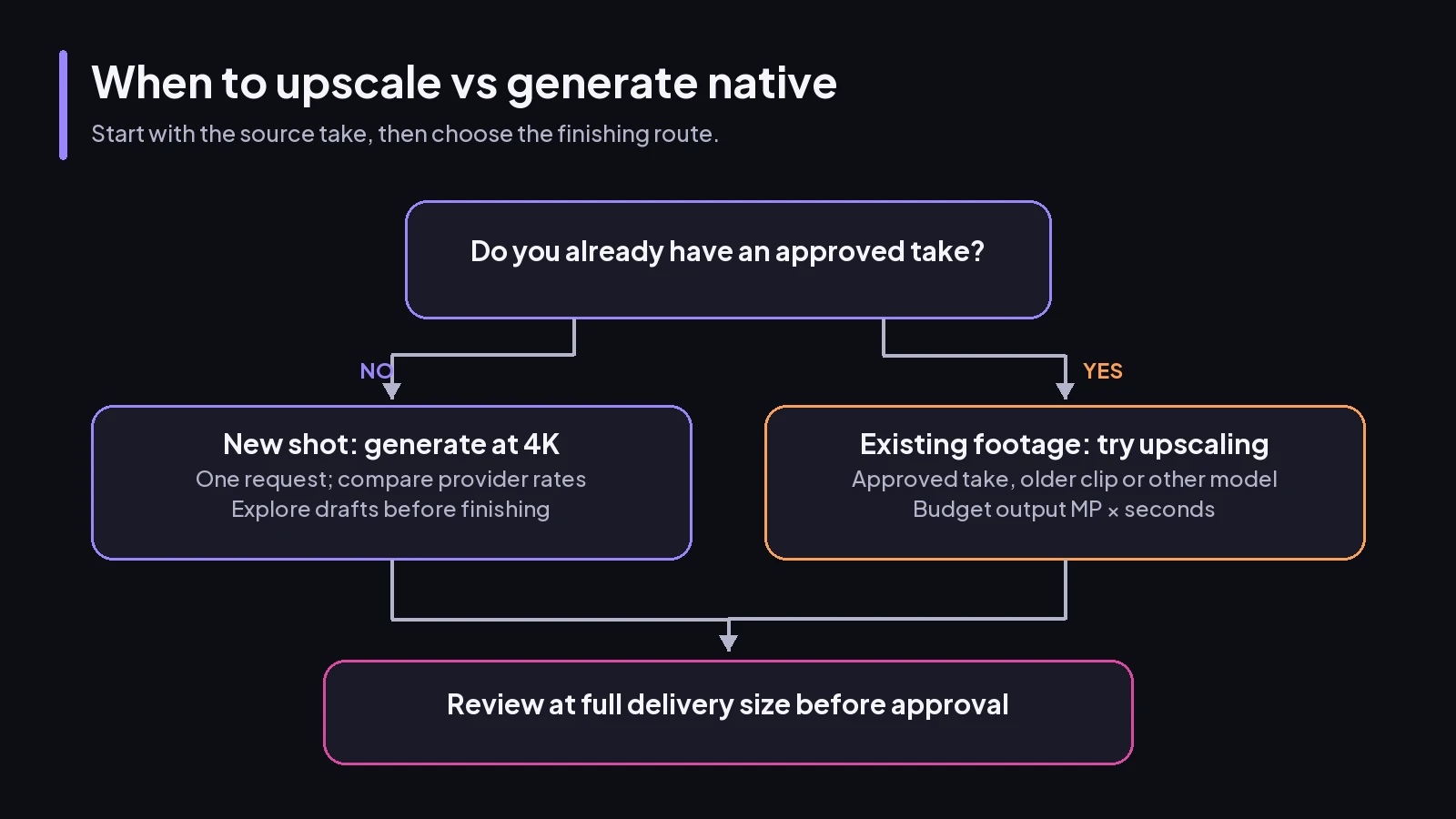
Editorial decision guide by PixVerse Blog; choose according to whether the source take already exists.
Lower the Cost per Approved 4K Clip
BFL says draft_enhance can finish a selected HD draft at 2K or 4K. Explore direction in drafts, choose a take, then enhance the winner. Treat this as a budget strategy to test, with both draft spend and the delivered-class finishing charge included. For workflow context, read our FLUX 3 review.
Track cost per approved 4K clip = total exploration and finishing spend ÷ approved clips. Review motion, edges, lettering and textures at full delivery size before approval. Record rejects as well as successful clips, and keep the source take so another finishing choice remains possible.
For your next creative test, start a video project in PixVerse.
FAQ
How much does 4K AI video cost per second with FLUX 3?
As of Oct 16, 2026, OpenRouter lists $0.41/s for generation, fal lists $0.47/s, and BFL reports $0.80/s direct. Continuation has separate rates.
Is it cheaper to upscale 1080p AI video to 4K?
For a new shot, our calculation from list prices gives $5.67 through route B versus $4.10 through A. For an existing approved take, the generation charge is already spent, leaving approximately $2.77 of new upscale cost under B’s settings.
How is FLUX Video Upscale priced?
BFL defines billing by output megapixels multiplied by seconds, on a 24 fps basis. Multiply by the provider’s mode rate and apply its supported frame-rate adjustment. Keep the exact output dimensions in the estimate.
Will these prices last?
OpenRouter announced one week of early access on Oct 15, 2026 (UTC) for the upgraded FLUX Video Upscale. Its $0.035/$0.05 per MP-second prices may change around Oct 22, 2026, our estimate from that announcement. Recheck current terms before placing a job; these are not guaranteed long-term prices.