Vidu Q4 Preview: 2026 Costs, Features, and Who It Fits
Source-based overview; facts checked Oct 14, 2026. Last updated Oct 14, 2026.
Vidu Q4 Preview is worth evaluating if your next video depends on a character’s performance, a recurring voice, or high-resolution delivery. Shengshu Technology announced it on October 7, 2026, positioning the model for short drama, advertising, and film production in its GlobeNewswire launch release.
For teams choosing a model, the practical questions are what those capabilities buy you and how much iteration costs. At the published USD list rates discussed below, ten seconds runs from $0.45 at 540p to $3.90 at 4K, before the applicable launch discount.
What’s new in Vidu Q4 Preview?
Performance and emotion
Shengshu’s launch release describes vendor-reported improvements in expressive acting, reference-voice consistency, lighting, and steadier camera movements and cuts.
For a short-drama team, we would test a quiet reaction before testing a spectacular action sequence. Ask for a pause, a change in expression, and a short reply. Review whether the eyes, mouth, posture, and voice communicate the same intention. That gives the performance claim a concrete acceptance criterion.
Reference voice and up to 15 images
Vidu’s Q4 Preview reference-to-video documentation accepts 1–15 images and up to three reference audio files. It specifies MP3 references lasting 3–12 seconds each. The same endpoint documents 3–16-second output, resolution options from 540p through 4K, and an audio-output switch.
Our recommendation is to give each reference a clear job: character appearance, wardrobe, location, product, or voice. Begin with the assets needed for the shot, then add references only when they resolve an ambiguity. A larger permitted reference pack is a control option; it does not establish a higher success rate.
There is a channel discrepancy: fal’s reference-to-video page describes a maximum of 12 images, while Vidu’s direct documentation says 15. Use the limit documented for your chosen endpoint and confirm it before preparing a batch. Do not assume a partner exposes every direct-API capability.
4K output and 10-bit color
Shengshu’s separate PR Newswire announcement lists vendor-reported 2K and 4K output with 10-bit color depth. It also describes the release as a preview ahead of the full Q4 model.
Treat that export claim as a reason to inspect a downloaded sample. For film work, check the actual file’s resolution, pixel format, codec, and color metadata in your editing workflow, including compatibility with your delivery specification. Judge acting and continuity separately from the output pixel count.
Vidu Q4 Preview pricing per 10 seconds
USD rates: identify the provider first
The GlobeNewswire release lists $0.045/second at 540p and $0.39/second at 4K, plus a 30% discount on image-to-video and reference-to-video through November 30, 2026.
For the complete USD resolution ladder, the table uses fal’s published image-to-video rates. Its reference-to-video page lists the same rates and promotion. These are fal channel prices. The partner pages currently use the name “Q4”; Vidu’s direct documentation uses “Q4 Preview.” Confirm the selected model when ordering.
| Resolution | USD list rate per second | List cost for 10 seconds | Promotional cost for 10 seconds |
|---|---|---|---|
| 540p | $0.045 | $0.45 | $0.315 |
| 720p | $0.095 | $0.95 | $0.665 |
| 1080p | $0.120 | $1.20 | $0.840 |
| 2K | $0.190 | $1.90 | $1.330 |
| 4K | $0.390 | $3.90 | $2.730 |
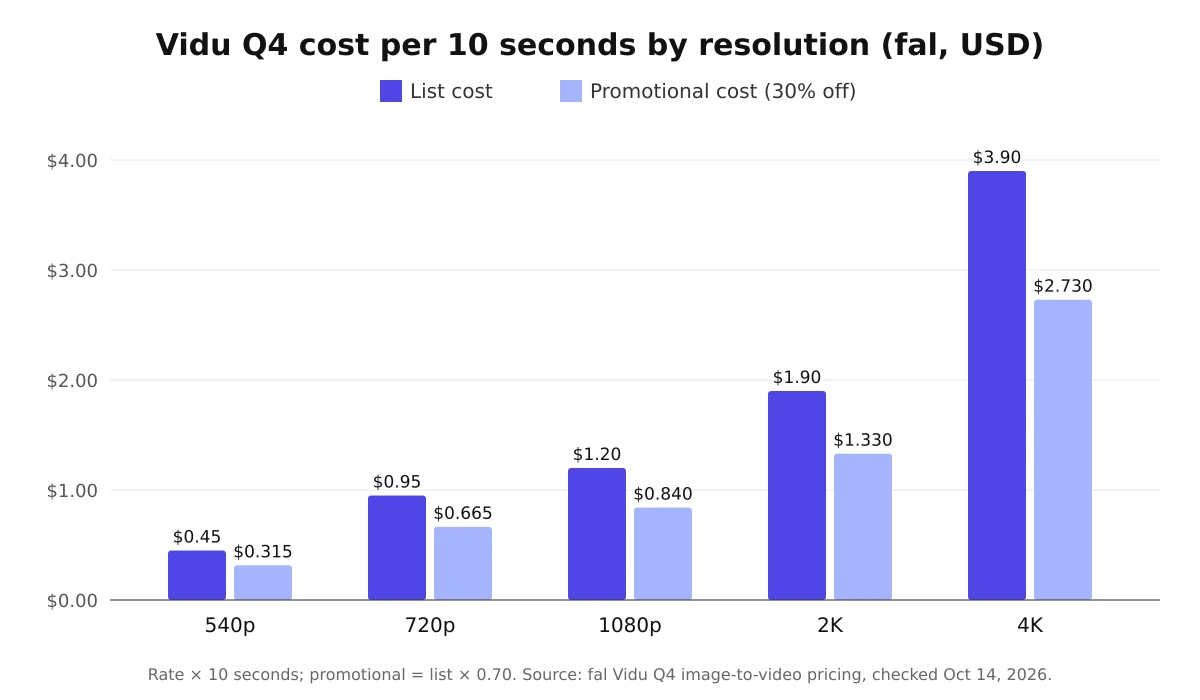
Chart built from the table above. Source: fal’s Vidu Q4 image-to-video pricing, checked Oct 14, 2026; ten-second totals are rate × 10, promotional totals × 0.70.
The ten-second totals are our arithmetic: rate × 10, with the promotional column applying × 0.70. Each total covers one generation. Confirm the offer at checkout; do not apply the discount twice to an already discounted quote.
What Vidu’s official pricing page confirms
Vidu’s current official API pricing document lists Q4 Preview image-to-video and reference-to-video at 9, 19, 24, 38, and 78 credits per second for 540p, 720p, 1080p, 2K, and 4K respectively. It displays a credit unit price of RMB 0.03125.
That means a ten-second direct-API request consumes 90, 190, 240, 380, or 780 credits at the listed rates. The document does not show the launch discount in those Q4 rows. Budget Vidu direct in credits and RMB; use fal’s dollar rates for fal requests.
There is another unresolved difference: the PR Newswire vendor release advertises a starting price of $0.014/second, without identifying the corresponding resolution in that statement. It says pricing and availability may vary by plan and region. That is a separate vendor quote; it is not the verified 540p list rate in the table. The 30% discount on $0.045 produces $0.0315, not $0.014.
Budget for usable takes
For an illustrative budget, five ten-second 1080p candidates at fal’s promotional $0.84 each cost $4.20. Track spending per approved shot and review time. Test composition and performance at a lower resolution first, then inspect the higher-resolution final again before approving it.
Who should put it on the shortlist?
For a useful shortlist, match the documented controls to your production bottleneck.
Short-drama teams: Evaluate Q4 Preview when a scene depends on recurring characters and vocal identity. Prepare a character sheet, a voice reference you are entitled to use, and one clearly described emotional beat. Compare dialogue and silent reactions, then check continuity across separately generated shots.
Advertising teams: Test it when a creative brief combines product references, a performer, and a controlled setting. Score product geometry, packaging, readable text, and the opening action before judging the overall look. Keep the same brief across variants so you can identify which direction actually improved the result.
Film teams: Consider a trial for performance studies, storyboard motion, or candidate shots requiring a higher-resolution export. Test the handoff into your editor early. A shot that looks convincing in a web preview still needs scrutiny for artifacts, continuity, sound timing, and export compatibility.
For each team, start with one representative shot and a spending limit. A small comparison using your own references will answer more than a montage selected by the vendor.
Choosing between Vidu, Seedance 2.5, and PixVerse V6
Choose around the production constraint you need to solve, then test the relevant controls with the same creative brief.
| Model | Source-backed reason to evaluate it | First thing we would test |
|---|---|---|
| Vidu Q4 Preview | Direct API documentation lists 3–16-second clips, up to 15 images, and reference audio; 4K/10-bit output is vendor-reported | Character performance, voice continuity, and the actual export |
| Seedance 2.5 | Vendor-reported 30-second standard clips, 180-second beta mode, R2V guidance, and up to 50 multimodal inputs | Whether a longer scene preserves the intended action and continuity |
| PixVerse V6 | PixVerse documents 15-second 1080p generation, native audio, multi-shot storytelling, and text/image inputs | Whether the required shots, camera movement, and sound work together |
The vendor-reported Seedance figures come from Dreamina’s official Seedance 2.5 page. Our existing Seedance 2.5 explainer provides context on its reference-led workflow. Fifty multimodal inputs and fifteen image references are different allowances, not interchangeable measures of quality.
PixVerse’s official V6 page describes its duration, resolution, audio, and multi-shot features. Our PixVerse V6 review explains a repeatable evaluation method. If your delivery fits 1080p, assess those controls against the same brief before paying for a 4K workflow.
For a fair cost comparison, match duration, resolution, audio, input type, and provider. Price Seedance 2.5 and PixVerse V6 using each account’s current estimate, and count retries before declaring a winner on price.
FAQ
How much does ten seconds of Vidu Q4 Preview cost?
The fal USD table above ranges from $0.45 to $3.90 at list rates, or $0.315 to $2.73 under its published launch promotion. Vidu direct uses the separately documented credit schedule. Confirm your provider and account quote.
Does the 30% discount apply to every Vidu model?
The cited launch offer concerns Q4 Preview image-to-video and reference-to-video through November 30, 2026. It does not establish a discount for every model or workflow.
Can I use 15 images through any provider?
Vidu’s direct Q4 Preview reference endpoint documents 15. Fal’s page says 12. Verify your chosen channel’s accepted inputs instead of transferring the direct limit automatically.
Is Vidu Q4 Preview better than PixVerse V6?
Compare the models against your delivery requirements. Vidu’s vendor-reported 4K/10-bit output makes export testing relevant; V6’s documented 1080p multi-shot and audio workflow makes it relevant to short-form production. Judge approved outputs and total spending for your actual assignment.
Related Resources
- Seedance 2.5: duration and reference workflow explained
- PixVerse V6 review and evaluation workflow
- How to create consistent characters with AI
If your brief calls for a short scene with planned camera movement and sound, build a V6 comparison clip in PixVerse. Keep the prompt and references, review what works, and let that result guide the next model choice.